I Presented My Research at HealCon 2026 and It Changed How I See My Work
I want to tell you about a moment that happened last month in Bellevue, Washington that I have been sitting with ever since.
I was standing next to my research poster at HealCon 2026, a functional and integrative health conference, when practitioners started stopping. Not just glancing. Actually stopping, reading, asking questions, wanting to talk. And the thing I kept hearing over and over was some version of the same thing: we don't see this type of work very often. This doesn't really exist yet in practice.
If you have ever worked in the wellness industry, you know what it feels like to work alone. To be at the intersection of things that don't usually talk to each other and wonder if anyone else sees what you see. That day in Bellevue, I realized I was not alone. And more importantly, neither are the athletes I work with.
What the Research Is Actually About
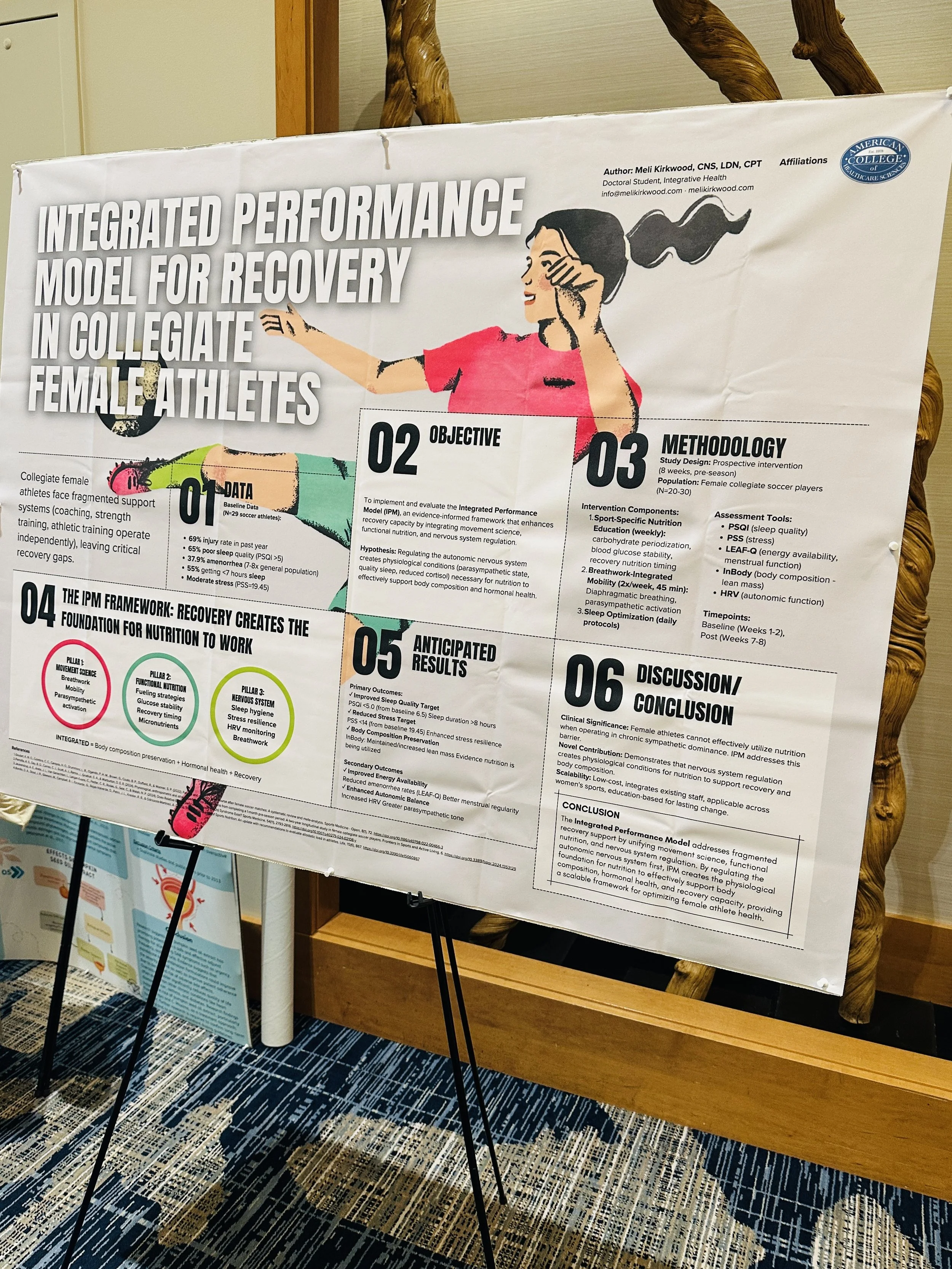
The poster I presented is titled Integrated Performance Model for Recovery in Collegiate Female Athletes, and it is the foundation of my doctoral research in Integrative Health.
Here is the problem it addresses: collegiate female athletes are operating with fragmented support systems. Their coaches, strength trainers, and athletic trainers are all working independently, leaving critical gaps in recovery. And the data reflects exactly that.
In a baseline sample of 29 collegiate soccer athletes, the numbers were striking. 69% had experienced an injury in the past year. 65% had poor sleep quality. 37.9% were experiencing amenorrhea, which is 7 to 8 times the rate of the general population. 55% were sleeping less than 7 hours a night. And stress levels were moderate to high across the board.
These are not outliers. These are the norm for female collegiate athletes. And the current model of care is not designed to address the root of it.
The IPM: What It Is and Why It Matters
The Integrated Performance Model (IPM) is an evidence-informed framework I developed that addresses this fragmentation by integrating three interconnected systems:
Pillar 1: Movement Science Breathwork, mobility, and parasympathetic activation. Before a body can recover, it needs to be physiologically capable of receiving recovery.
Pillar 2: Functional Nutrition Fueling strategies, glucose stability, recovery timing, and micronutrients. Nutrition does not work in isolation. If the nervous system is in a state of chronic stress, the body cannot effectively utilize what you feed it.
Pillar 3: Nervous System Regulation Sleep hygiene, stress resilience, HRV monitoring, and breathwork. The autonomic nervous system is the gatekeeper. Regulate it first, and everything else becomes more effective.
The core hypothesis of the IPM is this: regulating the autonomic nervous system creates the physiological conditions necessary for nutrition to effectively support body composition and hormonal health. Recovery is not the end goal. Recovery is the foundation that makes everything else work.
INTEGRATED = Body composition preservation + Hormonal health + Recovery
How the Study Works
This is a prospective intervention study conducted over 8 weeks during pre-season with female collegiate soccer players. The sample size is 20 to 30 athletes.
The intervention has three components. The first is sport-specific nutrition education delivered weekly, covering carbohydrate periodization, blood glucose stability, and recovery nutrition timing. The second is breathwork-integrated mobility twice a week for 45 minutes, focusing on diaphragmatic breathing and parasympathetic activation. The third is daily sleep optimization protocols.
To measure outcomes, the study uses validated tools including the PSQI for sleep quality, the PSS for stress, the LEAF-Q for energy availability, InBody for body composition and lean mass, and HRV monitoring for autonomic function.
What We Anticipate Finding
The primary outcomes we are tracking include improvements in sleep quality with a target PSQI score below 5, reduced stress with a PSS below 14 from a baseline of 19.45, and body composition preservation with InBody showing that nutrition is actually being utilized.
Secondary outcomes include improved energy availability, reduced amenorrhea rates, and enhanced autonomic tone reflected in HRV.
These are not small things. Amenorrhea in a young female athlete is a signal that the body does not feel safe enough to maintain hormonal function. Sleep disruption is not just fatigue, it is impaired recovery, impaired cognition, and impaired nutrient absorption. When we regulate the nervous system first, we change the entire physiological environment.
Why This Feels Important Beyond the Research
The clinical significance of this work is something I feel personally, not just academically.
Female athletes cannot effectively utilize nutrition when they are operating in chronic sympathetic dominance. That is not a motivation problem. That is not a compliance problem. That is a physiology problem. And the IPM is designed to address it at the root.
What makes this model scalable is that it is low cost, it integrates existing staff, and it is applicable across women's sports. It does not require building a new system from scratch. It requires connecting the systems that already exist.
The response at HealCon confirmed what I have felt for years in clinical practice: there is a gap in how we support female athletes at the intersection of nervous system health, functional nutrition, and movement science. And there are a lot of practitioners who feel it too, who have been working in their own corners of it, who are hungry for a framework that brings it together.
That is what the IPM is trying to be.
What Comes Next
This research is ongoing and tied to my doctoral dissertation in Integrative Health. As findings develop I will be sharing them here, on the podcast, and in clinical practice.
If you are a practitioner working with female athletes and any of this resonates, I would love to connect. If you are an athlete or a parent of a young female athlete and you recognize this picture, know that what you are experiencing is real and there are evidence-informed ways to address it.
The work is not siloed. It never was. We just needed a model to show how it connects.