What Is a Container of Safety and Why Your Nervous System Needs One
There are moments in life when we feel completely lost.
Not the kind of lost where you just need a map. The kind of lost where you don't know who to call, what to do next, or how to get back to the version of yourself that felt okay. You look around for a sign, a direction, a reason to take the next step, and nothing comes.
If you've ever been in that place, this is for you.
When You Don't Know Where to Turn, Go Back to What Once Gave You Life
One of the most powerful things you can do when you're feeling unmoored is return to what used to feel alive to you.
It doesn't have to look the same as it once did. Maybe dancing used to feel like pure freedom, and right now it just feels like going through the motions. Maybe journaling once filled pages effortlessly, and now you can barely write three sentences. Maybe the beach used to calm you instantly, and today it just feels like sand.
That's okay. The point isn't to recreate the past. It's to let those old anchors send you a signal. A signal that says: I'm still here. You can find your way back.
Think of it like breadcrumbs. The things that once gave you life are not gone. They are waiting for you, quietly pointing you home.
What Is a Container of Safety?
In nervous system work, the container of safety is a foundational concept rooted in polyvagal theory and somatic practice. It refers to the collection of people, places, sensations, practices, and experiences that signal to your nervous system: you are safe here.
When we are dysregulated, anxious, overwhelmed, frozen, or spinning, our brain is essentially scanning for threat. It's not looking for logic. It's not interested in your to-do list or your five-year plan. It wants one thing: a signal that you are okay.
Your container of safety provides exactly that signal.
It's not a coping mechanism in the traditional sense. It's not about distracting yourself from discomfort. It's about giving your nervous system something real and familiar to anchor to, so it can begin to downregulate and bring you back to yourself.
The beautiful thing is that your container is entirely personal. No two people's containers look the same, and that's exactly the point.
Why This Works: The Science Behind It
When we experience stress, our autonomic nervous system activates our threat response, what you might know as fight, flight, or freeze. This is a protective mechanism, and it's brilliant. But when it becomes chronic or gets triggered by everyday stressors, we need tools to help us complete the stress cycle and return to a regulated state.
Research in polyvagal theory, developed by Dr. Stephen Porges, tells us that our nervous system is constantly reading cues of safety and danger in our environment. These cues, called neuroception, happen below conscious awareness. They come from our body, our relationships, our surroundings, and our sensory experiences.
When we deliberately return to things that have historically felt safe, a song, a person, a place, a physical sensation, we are essentially speaking directly to our nervous system in its own language. We are saying, without words: this is familiar, this is known, I have been here before and I was okay.
That's not a small thing. That's the beginning of regulation.
My Own Container of Safety
Over the past year, I have done some of the deepest learning of my career. I completed my Biology of Trauma certification, my HeartMath certification, and the Play Zone training. I tell you this not to impress you, but because I want you to understand the depth of what I've been studying, and how it has changed the way I work with clients and with myself.
And through all of it, one thing kept showing up: dance.
In the research. In my own healing. In the ways we regulate, connect, and return to ourselves. It wasn't a coincidence, it was confirmation. Movement is medicine. Play is medicine. Your body already knows the way home.
So what does my personal container of safety look like? Here it is:
Dancing · My living room · Journaling · Music · The beach · Breathwork · Blueberry · Exercise · Sunlight · Nature · Stillness · Friends
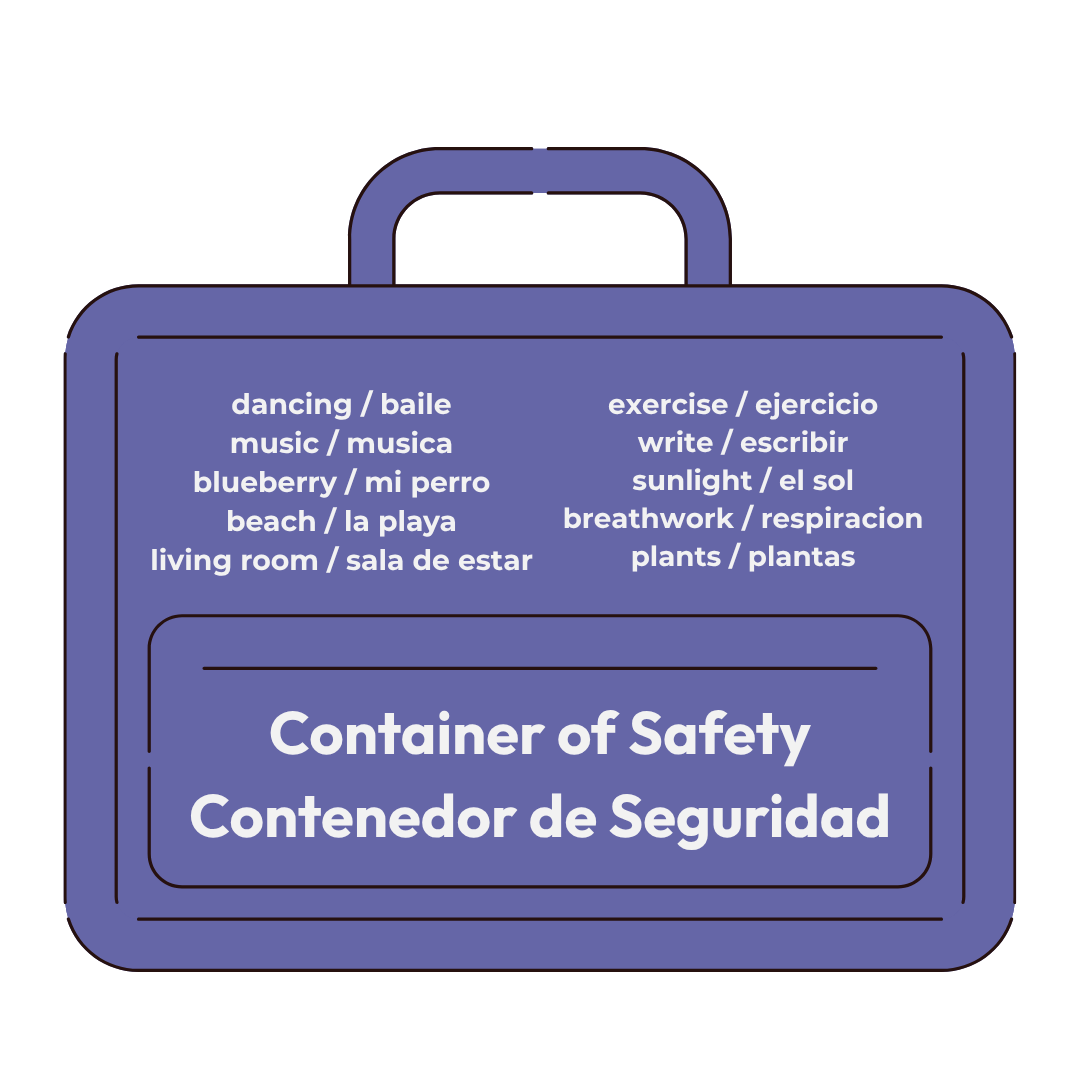
Some of these might surprise you. My living room? Absolutely. It is the way the sun hits my plant (Monstera Deliciosa) and how my couch feels. Familiarity and comfort are nervous system medicine. Friends? Without question. Co-regulation, the process of our nervous systems regulating through safe connection with others, is one of the most powerful tools we have.
Your list will look different. And it should.
How to Build Your Own Container of Safety
You don't need a certification to do this. You don't need a therapist's office or a special journal. You just need a few quiet minutes and an honest conversation with yourself.
Here's how to start:
1. Reflect on what has historically felt safe. Think back across your life, not just recently, but over the years. What places have made your body exhale? What people have made you feel seen without effort? What activities have made time disappear in the best way? What sensations, textures, smells, tastes, sounds, have felt like coming home?
2. Write it all down without editing yourself. This is not a productivity list. There are no wrong answers. Pets count. A specific mug counts. A song from 2003 counts. A street you used to walk down counts. Write it all down.
3. Draw it, doodle it, make it visual. Whether in your phone's notes app, a journal, or a sticky note on your mirror, make your container of safety visible. When we are dysregulated, we don't have easy access to our prefrontal cortex. We can't think clearly. A visual reminder removes the cognitive load and gives us something to reach for.
4. Keep it somewhere findable. Screenshot it. Pin it. Tape it to your fridge. The goal is that the next time your nervous system is spinning, you don't have to figure it out from scratch. You just open your container and reach for one thing.
One thing is enough. You don't have to do everything on the list. You just need one entry point, one familiar signal that tells your nervous system: I've been here before. I'm going to be okay.
A Final Invitation
If you've been feeling lost lately, in your career, your relationships, your sense of self, I want you to know that the path back doesn't require a dramatic overhaul. It doesn't require a new routine or a perfect plan or a breakthrough moment.
It might just require a song. A walk in the sun. A call to a friend who makes you feel like yourself. A slow breath with your hand on your heart.
Start there. Let your nervous system lead you home.
And if you don't yet have a container of safety, start building one today. Notice what gives you life. Write it down. Add to it over time. It will become one of the most important tools you have.
Meli Kirkwood is a Clinical Nutritionist, Doctor of Science candidate in Integrative Health, and the founder of Bululú Wellness, a bilingual functional performance nutrition practice based in Savannah, GA with virtual services nationwide. Her work sits at the intersection of functional nutrition, movement science, and nervous system regulation.
Ready to build your personal container of safety with support? Book a complimentary call